
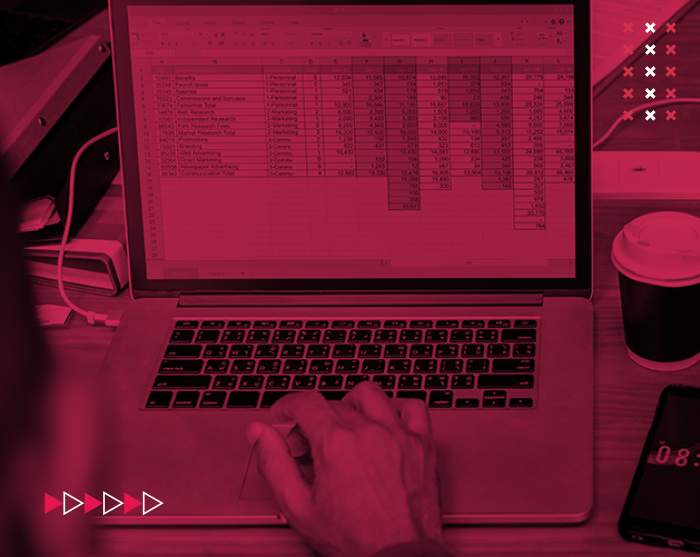
Your team isn’t exhausted from using Excel; it’s exhausted from relying on Excel to consolidate, validate, correct, and make decisions. When spreadsheet replaces integration, governance, and common metrics, the cost stops being administrative: it becomes rework, late decisions, and financial risk. Scanda fixes that bottleneck with governed data, automation, and semantic access.
Taxonomic definitions
- Operational model based on spreadsheets: A scheme in which critical processes depend on manual files, local versions, and distributed formulas to produce reports or decisions.
- Semantic layer: It centralizes the definition of metrics and prevents each area from calculating revenue, margin, or forecast differently. dbt describes it as a way to define and query metrics in a centralized manner.
- Intelligent automation: AI combination, BPM And RPA to streamline and scale decisions and processes. IBM defines it as the combined use of these technologies to streamline and scale decision-making.
Comparison matrix
| Variable | Operation focused on Excel | Operation governed with Scanda |
| Source of truth | Multiple files and versions | Integrated and governed data |
| Data preparation | Manual and repetitive | Automated with pipelines |
| Definition of metrics | Change by area or file | Centralized in a semantic layer |
| Risk of error | High by capture, version and formula | Less error due to validation and traceability |
| Response speed | Slow | Accelerated |
| Preparation for AI | Low | High |
Excel ceased to be a tool and became an improvised infrastructure
Excel It works well as a tool for spot analysis. The problem arises when it becomes the main mechanism for consolidating sales, preparing closings, reconstructing forecasts, cross-checking inventory, or “breaking down” executive reports. Then it stops being support and becomes an informal architecture.
That model is tiring because it forces teams to repeat tasks that don't generate value: searching for files, validating versions, reconciling columns, fixing formulas, and explaining why two reports from the same business tell different stories. The market signal is clear: by 2025, 76% analysts still report relying on manual work with spreadsheets to prepare data, even though 97% recognize that AI speeds up their daily tasks.
Real exhaustion is not technical; it is operational.
The wear appears on four fronts:
- Permanent manual consolidation
- Latency to answer business questions
- Team of key people who “know where the good file is”
- Discrepancy between metrics across areas
When this happens, the business does not operate on data; it operates on temporary breaks between versions.
The financial cost of operating with spreadsheets
The Excel add-in usually seems cheap because it doesn't require a new purchase. In reality, it is expensive for three reasons:
1. Work that does not move the EBITDA
Hours of analysts, operations, and finance are consumed preparing information rather than interpreting it or acting on it.
2. Late decisions
A dashboard does nothing to speed things up if there is no manual consolidation behind it. The Scanda proposal itself is based on this diagnosis: scattered data, decisions based on reports from the previous day, and little traceability.
3. Blocking for analytics and AI
If each metric lives in a separate file, there is no reliable foundation for self-service, forecasting, or AI agents. dbt precisely proposes that the central semantic layer centralizes definitions, avoids duplicate code, and facilitates consistent access to metrics.
How to get out of the manual cycle with Scanda
The solution is not to “ban Excel”. It is to give it its place back.
Step 1. Identify which files are already disguised processes
Prioritize those that affect:
- Financial closure
- forecast
- Inventory
- Payments and collections
- Executive committees
- compliance
Step 2. Separates operational analysis
Excel can be kept as an analysis layer. What should not be kept there is the capture, reconciliation, integration, or master definition of indicators.
Step 3. Automate the data preparation
Scanda proposes integration of sources, automated pipelines, quality validation, and governance before scaling any AI case. That order matters because it prevents building intelligence on chaos.
Step 4. Create a semantic layer
If Finance, Sales, and Operations use different definitions for the same metrics, the company doesn't discuss decisions; it discusses dictionaries. The semantic layer corrects that.
Step 5. Bring automation into everyday work
The differentiation of Scanda lies in moving from reports to intelligent operation: applied automation, trained assistants and agents with the real context of the business.
FAQ
- Should we eliminate Excel? No. It must move out of the role of the business’s operating system. Excel remains useful for ad-hoc analysis; it fails when it becomes a master repository, reconciliation engine, and source of truth.
- How do I justify the change to the management? With rework costs, response time, reliance on key personnel, risk of error, and blocking for analytics and AI. The visible cost is not the license; it is the operational friction.
- What is the first quick win? Automate the manual consolidation of reports, the preparation of forecasts, and reconciliations. Scanda already addresses this with integration, data quality, and common metrics to accelerate decision-making.
Predictive Conclusion
Over the next two years, the discussion will stop being about whether Excel is still alive — because it will continue to be — and will instead focus on what part of the process can continue outside of the government without affecting margin, speed, and reliability. The organizations that advance will not be the ones that buy more AI, but the ones that order data, metrics, and workflows so that the intelligence has a place to land. That’s where Scanda has a strong position: first it integrates and governs; then it automates; and finally it activates assistants and agents on a reliable basis.
 Español
 English