
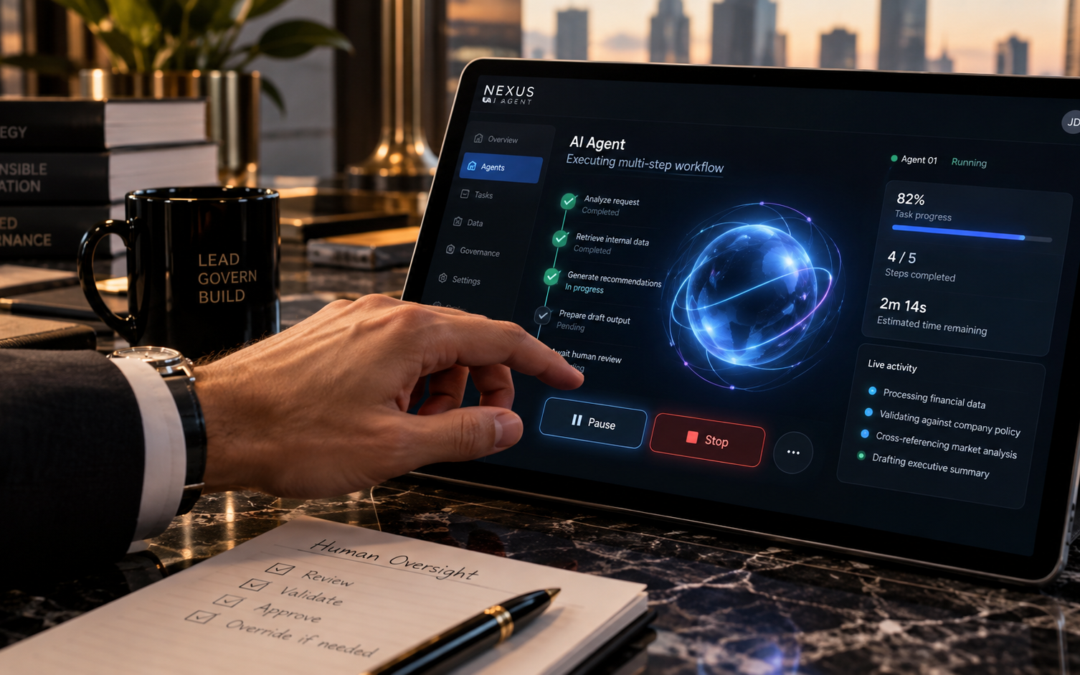
One company has approved a pilot of an AI agent that previously only answered questions. Now it sends emails to customers, adjusts inventory, or approves minor payments without anyone checking it line by line. The question asked in the room was the same as always: «Does it work?» The question no one asked was: «If it makes a mistake, who answers?»
That change in size is the one that almost no company has adjusted in their governance. Until recently, AI reported: it generated a report, a recommendation, a draft, and a person decided what to do with it. An agent acts: it directly executes the action on a real system. The question no longer becomes «what does the report say?» but «who is responsible for what the agent did?»
Almost nine out of ten companies already use AI in some form. Only between 5% and 6% achieve a significant impact on their financial results (McKinsey, The State of AI 2026). In Mexico, active adoption increased from 17% to 26% in a quarter, and only 7% report a consolidated return on those investments (KPMG, Global AI Pulse Q2 2026). The gap is not whether AI is used. It is whether someone can support with data that that AI generated value — and that someone is accountable for their decisions.
The cause is not the algorithm
When an AI pilot does not reach production, the explanation is almost never technical. Of every 33 proof-of-concept tests, only 4 reach production (IDC with Lenovo, 2025). The causes that recur most often are management-related: a poorly defined problem from the business, data that was not ready, costs that no one anticipated, and above all, risk without governance—in Mexico, 38% of the companies have no mechanism to assess the risk of their AI projects, and another 38% do so minimally and reactively (KPMG, Panorama of AI in Mexico and Central America 2025).
Without a government, two things happen: never an intermediate step: the pilot freezes up out of fear of escalating it, or they scale down without anyone having decided who answers if it fails. Neither of these is risk management. It is the absence of it.
The distinction that is lacking in most councils
There is a decision that should be made before approving any agent, and it is almost never mentioned: Does this project add AI to an existing process, or redesigns the process from AI? It is not the same thing. Adding AI to what you already do—AI Augmented—is faster to approve, easier to revert, and that is where any company that does not yet have stable AI systems in production should start. Redesigning an entire process from AI—AI Native—is a greater undertaking, and is reserved for when several systems are already operating with confidence.
Most of the advice I’ve seen agents adopt doesn’t distinguish between the two. They approve of the «AI project» with the same brush, without asking how reversible it is, or who operates it after launch.
What makes companies that do capture value different
Companies that achieve that 5-6% of significant impact do not have better models. They have a method: committed executive leadership from the beginning (almost 100% of the high-performing leaders versus 8% of the underperformers, according to BCG), shared governance between business and IT, and above all, nothing is built without first demonstrating value. At Scanda, we call this a PoV Gate: each initiative is evaluated in three dimensions — technical, business, and operational — before being built, and receives a verdict of GO, CONDITIONAL, or NO GO.
That evaluation is exactly the moment when the decision is made who answers. Not after the agent is already acting on actual data — before.
What doesn't change
No system should be designed so that the ultimate authority is not human. AI can propose, execute, and scale faster than any team; the responsibility for decision-making and response to the customer or the board remains with a person. Government does not exist to stop that — it exists so that progress can be made quickly, knowing, before building anything, who is responsible if something goes wrong.
Next step
Before approving the next agent in your company, the question isn’t whether it works. It’s whether you’ve already decided who answers when they decide to do it alone. A AI Value Discovery solves exactly that in two weeks: a map of AI opportunities with a GO, CONDITIONAL, or NO GO verdict, before committing budget. Schedule yours →
 Español
 English